Common Dry Dock Repair Mistakes and How to Avoid Them
A dry docking period concentrates months of inspection, maintenance and repair work into a narrow operational window. When planning, technical specifications or spare parts preparation are incomplete, relatively small issues can lead to additional work, off-hire time and unexpected costs. Effective dry dock repair support therefore begins well before the vessel enters the dock.
For shipowners, technical managers and marine superintendents, the objective is not simply to complete the repair list. The vessel should leave dock with critical systems inspected, repaired, tested and documented to a standard that supports reliable operation until the next scheduled maintenance period.
1. Starting Dry Dock Planning Too Late
One common mistake is treating the repair specification as a document that can be finalized shortly before docking. Work discovered from machinery history, class recommendations, statutory surveys and crew reports should instead be consolidated early.
Review previous dry dock reports, planned maintenance records, oil analysis, vibration trends, defect lists and outstanding class items. Chief engineers should identify machinery that cannot be properly inspected during normal operation, while superintendents should confirm which jobs require shore workshops, lifting equipment, machining or specialist attendance.
How to avoid the problem
Develop a prioritized work list with clear technical scope, dimensions, material specifications and acceptance criteria. Separate mandatory jobs from condition-dependent work and maintain contingency items for defects that may only become visible after opening machinery.
2. Using Vague Repair Specifications
Instructions such as ‘overhaul pump’ or ‘repair valve’ leave too much room for interpretation. A repair yard cannot accurately estimate labor, materials or machining without knowing equipment type, size, condition and required work.
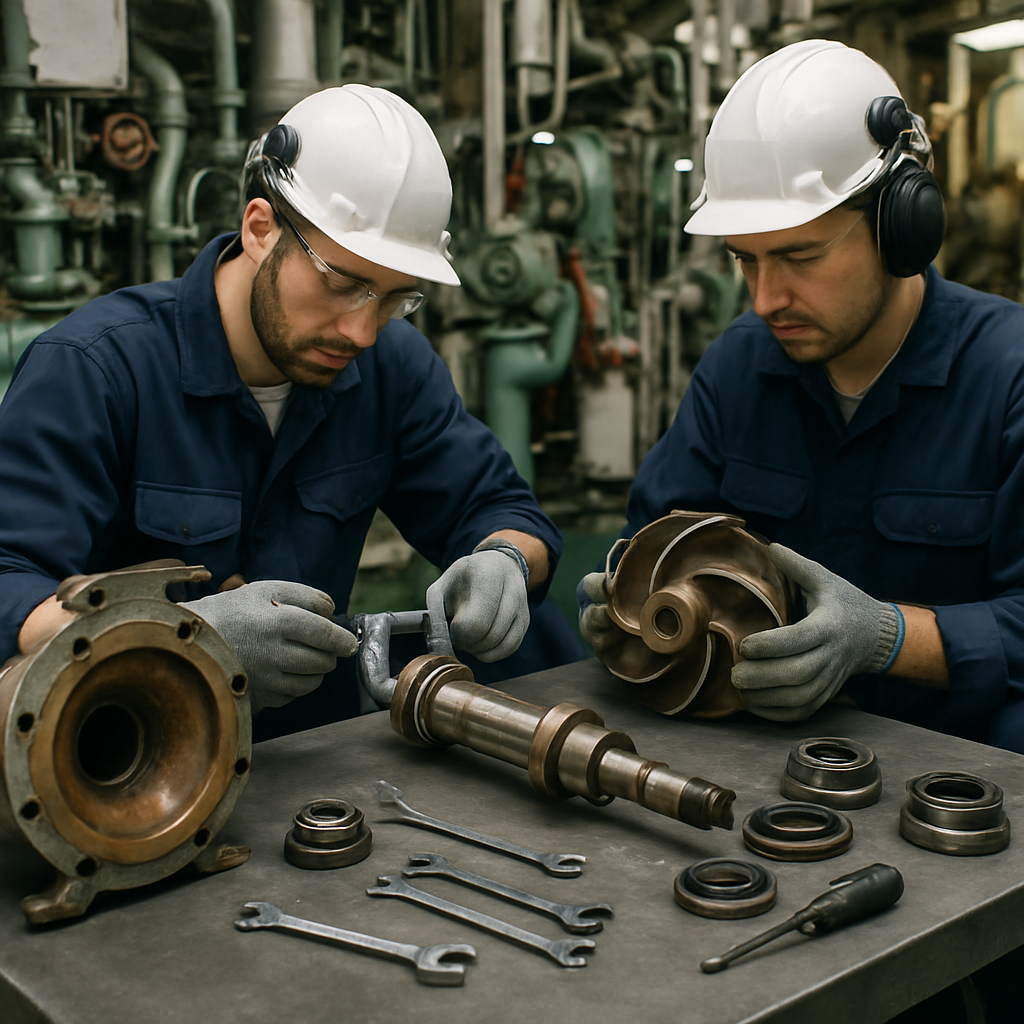
For a seawater pump, for example, specify whether the scope includes dismantling, shaft measurement, bearing renewal, mechanical seal replacement, impeller inspection, casing examination, alignment and operational testing. For valves, record nominal bore, pressure rating, material, connection standard and required seat or pressure testing.
Precise specifications improve quotation comparison and reduce variation orders during docking.
3. Ordering Spare Parts After Machinery Is Opened
Waiting for dismantling before arranging routine overhaul parts can cause expensive delays. Bearings, seals, O-rings, gaskets, valve components, pump parts and consumables should be identified in advance whenever service history supports planned renewal.
Purchasing teams should verify maker, equipment model, serial number, part number and technical dimensions before issuing an RFQ. For obsolete equipment, early identification provides more time to source equivalent components or arrange manufacturing based on samples and drawings.
Maintain a critical spare strategy
Prepare both planned overhaul kits and selected contingency spares. Particular attention should be given to cooling-water systems, pumps, compressors, purifiers, valves, deck machinery and other equipment whose failure could affect vessel readiness after docking.
4. Failing to Control Inspection After Opening
Dismantling is only the beginning of an overhaul. Components must be cleaned and inspected before deciding whether they can be reused. Bearings, shafts, sleeves, seal faces, valve seats, impellers and corrosion-prone casings require close examination.
Measurements should be compared with maker limits or established service criteria. Check shaft journals for wear, scoring and corrosion; inspect pump impellers for cavitation and erosion; examine valve seats and discs for pitting; and inspect pipe connections for thinning or galvanic corrosion. Where required, use dimensional checks or appropriate non-destructive testing.
Photographs and measurement records provide valuable evidence when the superintendent, class surveyor and repair contractor need to agree on additional work.
5. Ignoring Hidden Underwater Defects
The underwater hull, sea chests, gratings, valves, propeller, rudder and stern gear deserve systematic inspection once the vessel is dry. Heavy coating or marine growth can conceal corrosion, erosion and mechanical damage.
Inspect sea inlet gratings and sea chest internals after cleaning. Examine sea valves for body condition, seat integrity and operating mechanism condition. Inspect propeller blades for impact damage, erosion and suspicious surface indications. Rudder clearances, seals and visible bearing condition should be assessed according to the vessel’s survey requirements.
Do not close or coat an area until necessary inspections and measurements have been completed.
6. Poor Coordination Between Repair Teams
Dry dock jobs are often interdependent. Welding may affect nearby electrical equipment, pipe removal can restrict access, and painting can interfere with mechanical work. Poor sequencing creates repeated dismantling and unnecessary waiting.
A daily coordination process should identify critical-path jobs, access requirements, permits, isolation status, spare part availability and inspection hold points. The superintendent, ship staff and yard should clearly understand who is responsible for each stage.
7. Accepting Repairs Without Proper Testing
Completing physical work does not prove that equipment is ready for service. Pumps should be checked for leakage, pressure, abnormal noise and vibration. Overhauled valves may require pressure or tightness testing. Piping modifications should undergo the appropriate leak or pressure test before insulation and final coating obscure the work.
Following shaft-line, steering or propulsion-related work, verify required measurements and conduct operational tests in accordance with maker, class and vessel procedures. Record test results rather than relying solely on verbal confirmation.
8. Leaving Procurement Decisions Until the Last Days
Emergency procurement near dock completion often means fewer sourcing options and higher logistics risk. Keep a live list showing ordered, received, inspected and outstanding materials. Confirm that supplied parts match specifications before they reach the installation stage.
For urgent marine spare parts, provide suppliers with equipment name, maker, model, serial number, part number, quantity and vessel location. Clear photographs of nameplates and existing components can significantly reduce identification errors.
How UNICO Vietnam Supports Dry Dock Projects
UNICO Vietnam provides dry dock repair support, marine spare parts, marine equipment, ship chandler services and technical support for shipowners, ship managers, superintendents and engineering teams. From Hai Phong, Vietnam, we can assist with spare part identification, sourcing, technical coordination and supply requirements for scheduled repairs and urgent vessel needs.
Early RFQs allow more time to verify technical details, compare suitable supply options and prepare critical parts before the docking schedule becomes compressed.
Reduce Dry Dock Risk Through Preparation
Successful docking depends on preparation, accurate specifications, disciplined inspection, coordinated execution and documented testing. The most expensive dry dock repair mistake is often not the defect itself, but discovering it without sufficient time, technical information or spare parts to resolve it efficiently.
For marine spare parts and dry dock repair support, contact UNICO Vietnam at unicovietnam.com, email sales@unicovietnam.com, or WhatsApp/Zalo +84 93 662 8883.
 English
 Tiếng Việt
 简体中文